When “She’s Just Tired” Isn’t Enough: What Gymnastics Coaches Need to Know About Nutrition
As a gymnastics coach, you probably notice things that parents don’t.
You see the athlete who walks into the gym already exhausted.
You see the gymnast who used to bounce back between routines but now looks completely drained.
You notice when they’re struggling to concentrate, getting frustrated more easily, or just doesn’t seem like themself.
You notice when they’re constantly sore.
When little injuries seem to keep popping up.
When skills that used to feel consistent suddenly aren’t.
When that athlete seems to be working harder and harder, but getting less and less out of training.
And maybe you’ve found yourself thinking:
“They’re just tired.”
Because gymnastics is hard.
Our athletes are training a lot.
Going through a busy school year.
Probably not sleeping enough.
Typical pre-teen and teenager stuff.
There are a million possible explanations.
And sometimes, yes, they are just tired (contrary to popular belief, gymnasts are not robots).
But sometimes there’s more to the story.
And that’s where things can get uncomfortable for coaches.
Because you may notice that something isn’t right…
…but you may not know what isn’t right.
You may wonder if nutrition is part of the picture.
You may suspect they’re not eating enough.
You may notice that they rarely come into the gym with food.
You may hear negative talk about food or body.
You may see them struggling to recover from one practice to the next.
But then comes the next question:
What am I actually supposed to do about it?
When you know something is wrong, but don’t know what to do next
As a registered dietitian working in the sport of gymnastics (and a former high level gymnast and gymnastics coach), this is one of the biggest gaps I see when working with gymnastics coaches.
Coaches are often incredibly observant.
They know their athletes.
They know what “normal” looks like for each gymnast.
They know when an athlete’s energy, attitude, performance or behavior has changed.
But recognizing that something is different and understanding why it’s happening are two very different things.
And nutrition can be especially tricky.
Because most coaches aren’t nutrition professionals.
You may have picked up bits and pieces over the years.
Maybe you’ve heard that athletes need protein.
Maybe you’ve been told carbohydrates are important or sugar is bad.
Maybe you’ve read something about hydration or recovery.
Maybe you’ve attended a nutrition lecture at a congress.
But when an athlete in front of you is struggling?
Knowing a few nutrition facts isn’t necessarily enough to know what to do.
You may be asking yourself:
Are they actually under fueled?
Is this amount of fatigue normal?
Should I be talking about eating more?
What if I say the wrong thing?
Should I talk to the parents?
Is this something I should even handle? Or is it outside my role?
When does “she’s tired” become something I should be concerned about?
Those are important questions.
And you don’t have to have all of the answers yourself.
Your job isn’t to be your gymnast’s dietitian
Let me say this clearly because I think it’s really important:
I don’t want gymnastics coaches to become dietitians.
Your job is to coach gymnastics.
You shouldn’t be expected to write meal plans. You shouldn’t be diagnosing nutrition-related conditions. You shouldn’t be trying to manage an athlete’s nutrition on your own. And you shouldn’t feel like you need to know everything about nutrition before you can support your athletes.
But there is a middle ground.
You can be an informed coach. You can understand enough about nutrition to recognize when something may be worth paying attention to. You can learn how to have supportive conversations without creating fear or shame around food.
You can understand when something is within your role, and when it’s time to bring in a parent, sports dietitian, physician or another qualified professional.
And honestly?
I think that middle ground is incredibly important in gymnastics.
Because coaches are often the people who see these athletes over and over again.
You see them multiple times a week.
You see how they move.
You see how they train.
You see their energy.
You see their recovery.
You hear the comments they make.
And sometimes, you’re the first person who notices that something has changed.
You don’t need to know everything. But you do need to know when something matters.
I think there’s a misconception that being an informed coach means having an answer for every nutrition question.
It doesn’t.
Sometimes being an informed coach looks like saying:
“I’m noticing something, and I think we should get you some support.”
That’s it.
You don’t have to solve the problem. You don’t have to figure out exactly what’s happening. You don’t have to Google symptoms at midnight. You don’t have to give the athlete a list of foods to eat.
You just need to recognize that something may need more attention.
And that requires education.
Not because coaches aren’t capable.
But because you can’t recognize what you don’t know to look for.
What if your coaching staff isn’t on the same page?
There’s another piece of this conversation that I think we need to talk about.
Even when a coach understands the importance of fueling, what happens when the rest of the staff doesn’t?
One coach encourages athletes to bring snacks. Another questions why they’re eating during practice and rushes them to the next event.
One coach understands the importance of recovery. Another tells an athlete to simply “push through.”
One coach knows that comments about body size aren’t appropriate. Another makes what they think is an innocent comment about how an athlete looks.
None of these coaches may have bad intentions.
They may simply have different levels of education.
But the athlete is the one left trying to make sense of all of it.
That’s a problem.
Because athletes don’t just hear what we say.
They absorb the environment we create around them.
And creating a supportive nutrition environment doesn’t require every coach on your staff to become a nutrition expert.
It starts with having a shared understanding of the basics.
Shared language.
Shared expectations.
And a clear understanding of when to support, when to step back and when to refer.
So…what should a gymnastics coach know about nutrition?
That’s the conversation I’m so incredibly passionate about having.
Not because coaches need another thing added to their already very long list of things to know and do.
But because nutrition, recovery, and athlete health are already part of the gymnastics environment.
The question isn’t whether coaches will encounter these issues.
They will.
The question is whether they’ll feel prepared when they do.
And if you’ve ever found yourself standing in the gym thinking…
“Something seems off, but I’m not sure what I’m looking at.”
Or…
“I want to help, but I don’t want to make things worse.”
Or…
“I wish I knew more about this.”
Please know that you’re not alone.
And you don’t need to know everything.
You just need to start learning.
A new resource for gymnastics coaches is coming
This is something I’ve been working on for a while, and I’m incredibly excited to finally start sharing it.
I’m creating The Fueled Gymnast: Coaches Series specifically for gymnastics coaches who want to feel more confident supporting their athletes around nutrition, recovery and athlete health.
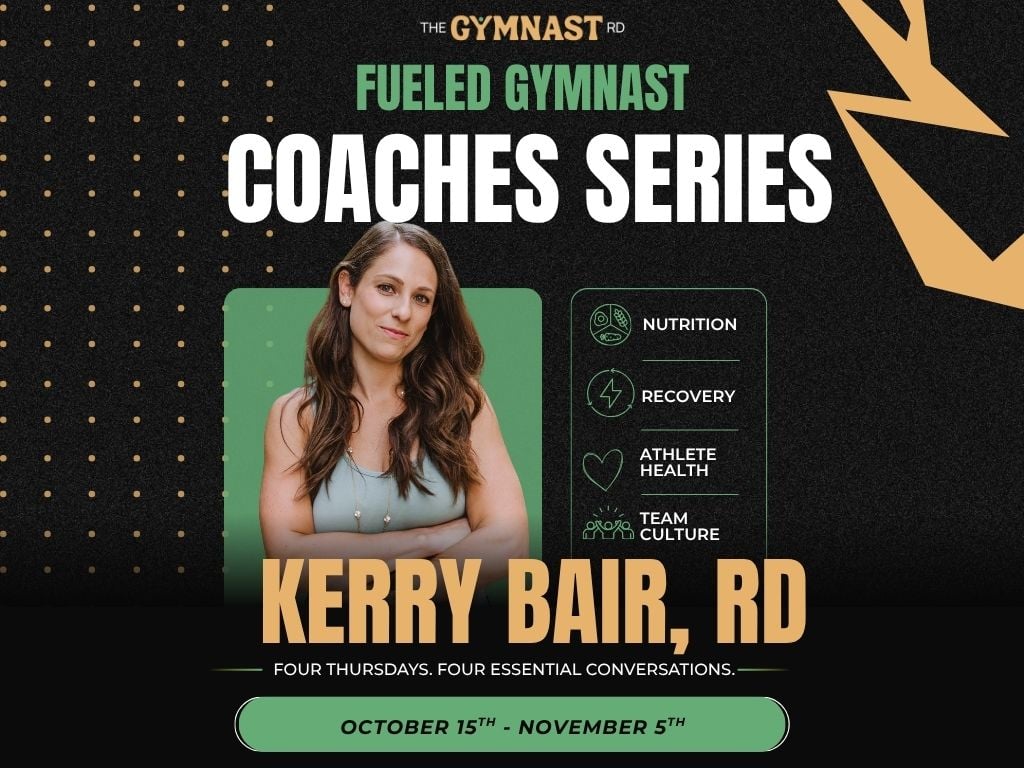
It’s designed around the questions I hear from coaches all the time:
What should I know?
What should I look for?
What should I say?
What should I do?
And when is it time to bring someone else in?
I’ll be sharing more details soon, but registration for the full series is open (both for yourself and for your entire coaching staff).
If you’re a gymnastics coach or a gym owner who wants to give your coaching staff a stronger foundation around these topics, you can join me for the full Coaches Series here.
Because your athletes don’t need perfect coaches.
They don’t need you to have every answer.
They need coaches who are willing to notice, learn, ask questions and advocate for them.
And sometimes, the first step is simply realizing: “I want to know more.”
That’s where this starts.