5 Things Coaches Shouldn’t Ignore in a Tired, Struggling Gymnast
“She’s just tired.”
It’s something I hear a lot in gymnastics.
And honestly?
Sometimes he or she is just tired.
Gymnastics is hard.
Training is demanding.
School is demanding.
Growing is demanding.
And yes, sometimes athletes have a bad practice, a rough week, or simply need a little extra rest (they’re not robots).
But what happens when “tired” starts becoming the norm?
When the gymnast who used to bounce back between practices suddenly seems exhausted all the time?
When little injuries keep popping up?
When skills that used to feel solid suddenly aren’t?
When they seem frustrated, distracted, or just…different?
That’s when I want coaches to pause.
Not panic.
Not diagnose.
Just pay attention.
Because coaches are often in a unique position to notice changes in an athlete before anyone else does.
You see them multiple times a week.
You see how they move.
You see how they respond to training.
You see when something feels different.
And sometimes, those changes are worth a closer look.
Here are 5 things I don’t want coaches to automatically brush off as “normal gymnastics.”

1. They’re tired ALL the time.
There’s a big difference between being tired after a hard practice and being chronically exhausted.
Maybe they used to finish practice strong, and now they’re dragging by the end.
Maybe they’re struggling to stay focused during training.
Maybe they’re constantly talking about being tired.
Maybe it seems like they’re running on empty before practice even begins.
Again, this doesn’t automatically mean nutrition is the problem. There are a LOT of reasons an athlete can feel tired. But persistent fatigue is information.
And instead of automatically thinking:
“She just needs to push through.”
It may be worth asking:
“Has something changed?”
2. They’re never really recovering.
One hard practice or a new drill, skill or conditioning phase followed by 1-2 days of soreness?
Totally normal in gymnastics.
But what about an athlete who is always sore?
They come into the next practice still feeling beat up.
Their muscles never seem to bounce back.
They’re struggling to keep up with the demands of training. Or they need significantly longer to recover than they used to.
Recovery doesn’t happen because an athlete simply stops moving for a few hours.
The body needs the resources to repair, adapt, and prepare for the next training session.
That means things like:
- Fuel.
- Hydration.
- Sleep.
- Rest.
- And appropriate training load.
If recovery consistently isn’t happening, I don’t want the automatic response to be:
“Just keep working.”
Sometimes the better question is:
“What is missing?”
3. The injuries keep coming.
One injury happens.
It gets treated.
They come back.
Then another injury happens.
Then another.
Or maybe your athlete is dealing with nagging aches that never quite seem to go away.
In gymnastics, injuries are unfortunately part of the sport.
But frequent or recurrent injuries deserve attention.
That doesn’t mean every injury is caused by nutrition.
It isn’t.
But nutrition, recovery, training load, growth, and overall health can all be pieces of the bigger picture.
And this is an area where coaches don’t need to figure out the “why” themselves.
They just need to notice the pattern.
“She keeps getting hurt” is worth communicating.
4. Performance has changed.
This one can be especially easy to miss.
Because sometimes we assume a struggling athlete simply needs to work harder.
Maybe skills aren’t as consistent.
They’re having a harder time getting through routines.
Endurance seems lower.
They’re struggling to concentrate.
They’re making mistakes they normally wouldn’t make.
Or they are just not performing like themself.
And before we immediately assume our athletes need more conditioning, more repetitions, or more intensity…
Let’s consider whether they have the capacity to handle the work they’re already doing.
Because sometimes what looks like a motivation problem is actually a support problem.
5. They just don’t seem like themself.
This might be the hardest one to put into words.
But coaches know their athletes.
You notice when the usually energetic gymnast becomes withdrawn.
When the confident athlete becomes unusually frustrated.
When someone who normally loves practice seems like they’re just trying to survive it.
When food suddenly becomes a source of stress.
When they’re struggling to concentrate.
When their mood seems different.
None of these things, on their own, tell you exactly what’s going on.
And that’s important.
These are signs to notice, not diagnoses.
There could be something happening with nutrition.
There could be something happening with sleep, stress, school, mental health, training load, growth, or something completely unrelated to the gym.
That’s why the goal isn’t for coaches to figure it all out.
The goal is to notice the change and know what to do next.
So what should a coach actually do?
This is where I think coaches sometimes get stuck.
Because once you start noticing these things, you may think:
“Okay…but now what?”
And I want to make something very clear:
You don’t need to become a dietitian.
You don’t need to diagnose low energy availability.
You don’t need to diagnose REDS.
You don’t need to write a meal plan.
You don’t need to start monitoring what an athlete eats.
And you definitely don’t need to have all the answers.
But you do need to know when something isn’t adding up.
You need to know how to have appropriate conversations.
You need to understand when to involve a parent.
You need to know when something should be referred to a qualified healthcare professional.
And you need to understand how the environment you’re creating in your gym can either support an athlete…
or make things harder.
That’s what coach education is really about.
Not turning coaches into healthcare providers.
Giving them enough knowledge to recognize when an athlete needs more support.
Because “normal for gymnastics” isn’t always normal.
This is something I wish I could go back and tell my younger self.
I thought being exhausted was normal.
I thought constantly pushing through was what committed athletes did.
I thought being sore all the time was just part of training.
And I know now that our athletes deserve better than simply being told to tough it out. They deserve adults who understand that training is only one piece of the equation.
Fueling matters.
Recovery matters.
Sleep matters.
Growth matters.
Health matters.
And sometimes the strongest thing a coach can do isn’t push an athlete harder.
It’s recognize when she needs something different.
This is exactly why I created The Fueled Gymnast: Coaches Series.
Because I don’t want gymnastics coaches to become dietitians.
I want them to feel more confident when they’re standing in the gym thinking:
“Something feels off, but I don’t know what to do.”
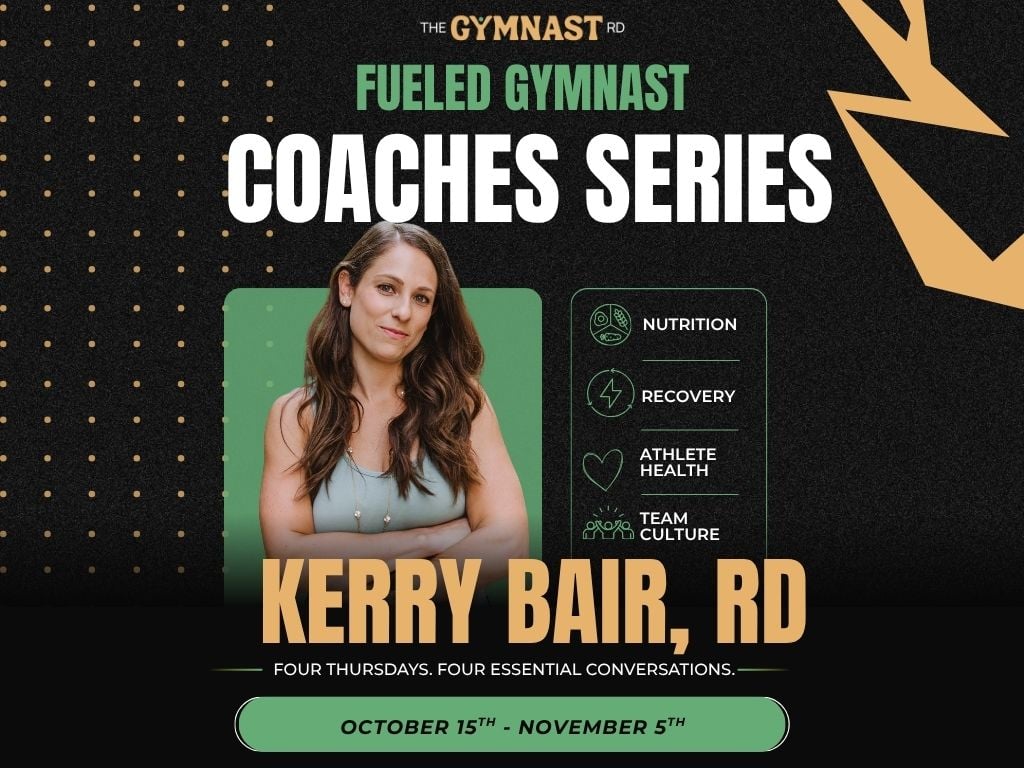
The four-part series covers:
Sports Nutrition Basics for Coaches
Early Warning Signs of Low Energy Availability, Before It Becomes RED-S
The Recovery Gap: Why Gymnasts Aren’t Rebounding and How to Get Them to Bounce Back
Fueling As A TEAM: Building a Culture of Fueling For Your Gym
We’ll talk about what coaches should know.
What they can say.
What they should avoid.
How to support athletes.
And when it’s time to bring in someone with specialized expertise.
Because your gymnasts don’t need perfect coaches.
They don’t need coaches who know everything.
They need adults who are willing to keep learning.
The Fueled Gymnast: Coaches Series begins October 15.
All four workshops are live, and recordings are available to registrants.
If you’re a coach, I’d love to have you join me.
And if you’re a parent reading this, send it to your gymnast’s coach or gym owner. ❤️