How to Help Your Gymnast Actually Improve Over Summer (Not Just Train More)
Summer is often seen as the season where gymnasts finally get ahead.
More hours in the gym.
More conditioning.
More skill attempts.
More camps.
More focus on upgrades and next season goals.
And while all of this can be valuable, there’s one big misconception that shows up every year: Training more automatically leads to improving more.
But in reality, that’s not always what happens.
Some gymnasts train more and improve.
Some train more and stay the same.
Some train more and end up exhausted, sore, and frustrated by August.
So what actually makes the difference?
It usually comes down to one thing; Whether the body is supported well enough to adapt to the training being done.
Because improvement in gymnastics doesn’t happen just from doing more skills. It happens from how the body responds to the work being put in.
And that response depends on recovery, energy, fueling, and overall support.
Training More Doesn’t Always Mean More Progress
It’s easy to assume that if your gymnast is spending more time in the gym, progress should naturally follow.
More reps should lead to better skills.
More conditioning should lead to more strength and better endurance.
More skill attempts should lead to consistency.
But the body doesn’t work like a simple input-output machine.
Gymnastics training places a high demand on:
- Muscles
- Bones
- Joints, Tendons, and Ligaments
- Nervous system
- Energy stores
- Recovery systems
And if these systems aren’t supported properly, the body shifts into protection mode instead of growth mode.
This can look like:
- Feeling tired during practice
- Strength gains slowing down
- Endurance struggling
- Skills not clicking
- Soreness lingering longer than expected
- Increased risk of minor injuries
- Frustration building over time
Not because the gymnast isn’t working hard, but because the body doesn’t have the resources it needs to improve.
What Actually Drives Improvement Over Summer
If summer is meant to build strength, stamina, skills, and confidence for next season, then the focus needs to go beyond just training hours.
There are a few key areas that truly drive progress.
1. Enough Energy to Support Training
Gymnastics is a high-output sport.
Summer training often increases:
- Practice hours
- Conditioning volume
- Skill repetitions
- Physical and mental load
Which means energy needs increase too.
When energy intake doesn’t match energy output, the body starts conserving:
- Instead of building strength, it adapts to store energy as fat mass.
- Instead of adapting to training, it slows recovery.
- Instead of improving endurance, fatigue builds faster.
This is why fueling consistently throughout the day becomes so important.
Meals and snacks aren’t just about eating healthy.
They’re about giving the body enough fuel to train, recover, and grow stronger.
2. Recovery that Actually Allows the Body to Adapt
Improvement doesn’t happen during practice.
It happens after practice.
Training creates stress on the body, and recovery allows the body to rebuild and adapt.
Without proper recovery:
- Muscles don’t repair efficiently
- Energy stores stay low
- Soreness lasts longer
- Performance drops over time
Recovery includes:
- Adequate fueling
- Post-training nutrition
- Hydration
- Sleep
- Rest between sessions
When these pieces are consistent, training starts to produce better results.
When they’re not, gymnasts often feel like they’re working hard without seeing progress.
3. Strength and Endurance is Built from the Inside Out
Conditioning alone doesn’t build strength.
Fueling supports strength.
Endurance doesn’t just come from running more or doing more circuits.
It comes from having enough energy available to sustain effort.
When the body is properly fueled, gymnasts often notice:
- Better stamina in long practices
- More consistent strength
- Improved focus
- Faster recovery between turns
- Better ability to repeat skills
Which leads to better overall progress
4. Consistency Over the Entire Summer
One of the biggest factors in summer improvement is consistency.
Not just in training, but also in:
- Eating regularly
- Fueling before and after practice
- Staying hydrated
- Supporting recovery
- Sleep schedules
Because progress builds slowly over time.
It’s not about one perfect week, it’s about steady support across the entire summer.
Small daily habits create big seasonal improvements.
Summer is An Opportunity to do Things Differently
Summer is one of the best times to reset and build a stronger foundation.
Not just with skills, but with support.
It’s a chance to:
- Reflect on the past season
- Identify what may have been missing
- Understand how fueling impacts performance
- Build better habits
- Support strength and endurance
- Help the body adapt to training more effectively
Instead of repeating the same approach and hoping for different results.
You Don’t Have to Figure This Out Alone
Supporting a gymnast through a demanding summer season can feel overwhelming.
There’s a lot of information out there.
A lot of conflicting advice.
And a lot of uncertainty about what actually makes a difference.
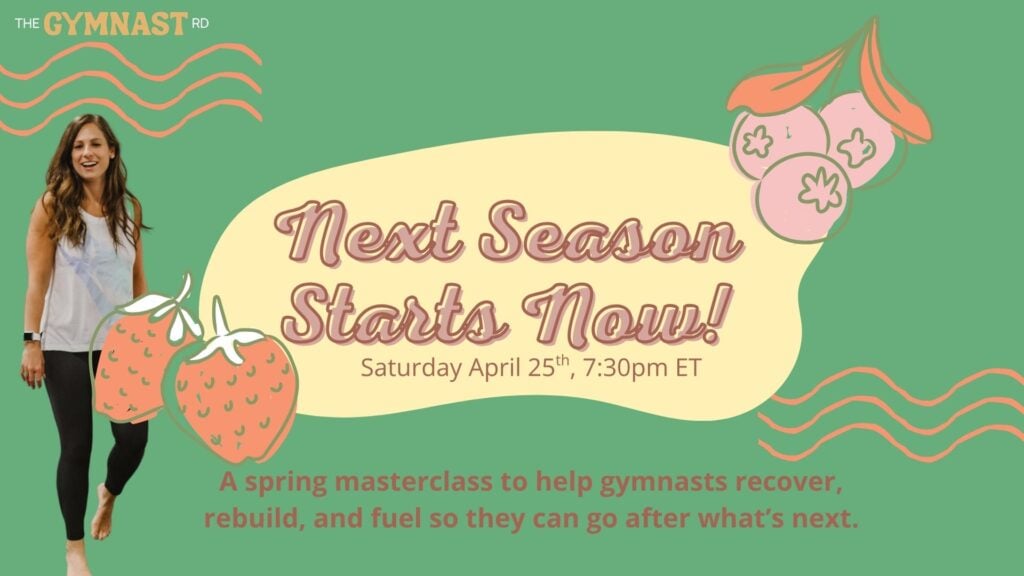
That’s exactly why I created a brand new master class, Next Season Starts Now
To help gymnasts and parents understand:
- What the past season may have revealed
- How fueling impacts performance
- What supports strength and endurance
- How to improve recovery
- How to better prepare for summer training
- How to help gymnasts actually improve — not just train more
So families can head into summer with clarity and confidence.
Register For the Masterclass
If your gymnast has big goals for summer and you want to make sure her nutrition is supporting her progress, this masterclass is for you.
Next Season Starts Now is a brand new masterclass designed to help gymnasts and parents:
- Reflect on the past season
- Understand what may have been getting in the way
- Learn how to support energy, recovery, strength, and endurance
- Head into summer with a clear plan
Registration is now open for the April 25 masterclass
👉 Register through here to secure your spot