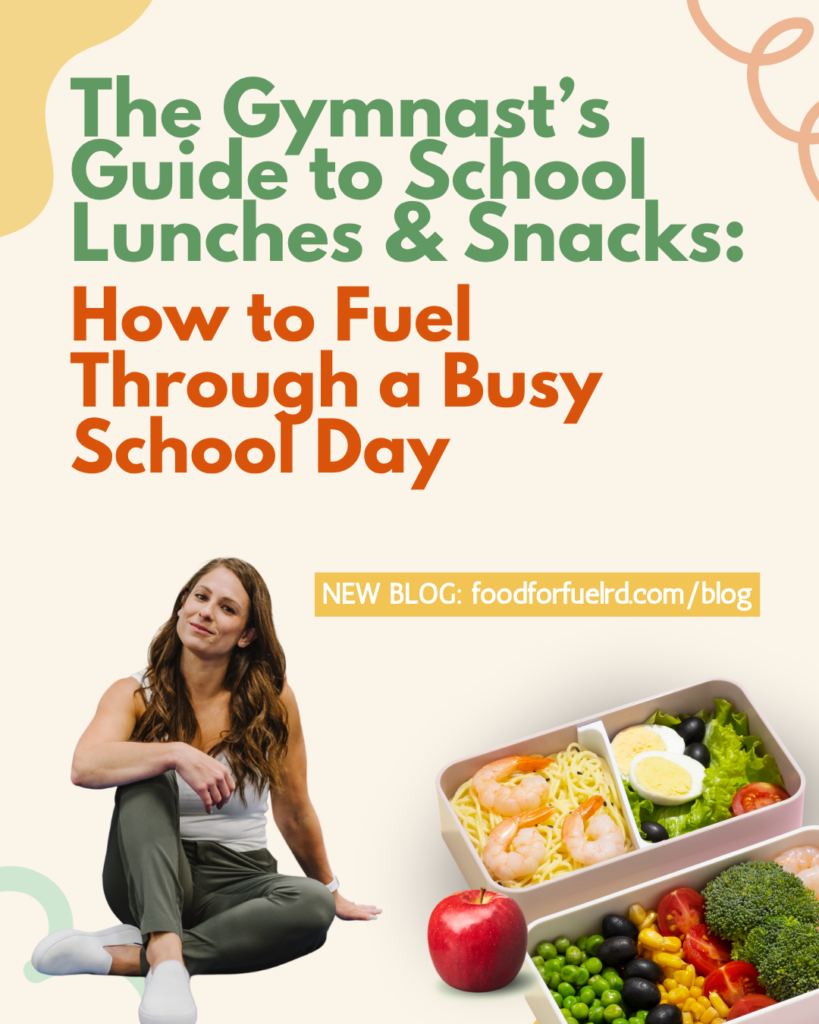
The Gymnast’s Guide to School Lunches & Snacks: How to Fuel Through a Busy School Day
For a gymnast, school days are long and busy.
Your gymnast eats breakfast, heads to school, spends several hours in class, squeezes in lunch (maybe a snack if they’re lucky), and then may go straight from the school bell to gymnastics practice.
That’s a LOT for a growing, active body to handle.
And one of the biggest challenges I see with gymnasts during the school year isn’t that they don’t know what healthy foods are.
It’s that they simply aren’t eating enough food throughout the day.
Lunch gets rushed.
The snack gets forgotten.
They don’t like what was packed.
They only have 15 minutes to eat.
Or they’re so excited talking to their friends that they realize halfway through the afternoon that they barely touched their lunch. 😂
Then suddenly it’s 4:00 PM, practice starts at 4:30, and your gymnast is expected to train for 3-4 hours.
That’s a hard situation to recover from.
The good news?
School lunches and snacks don’t need to be complicated.
You don’t need a perfectly curated bento box every day. You don’t need to make everything from scratch. And you definitely don’t need to stress if your gymnast doesn’t want to eat a vegetable at lunch.
What your gymnast needs is a reliable opportunity to eat enough food throughout the school day so they can get to practice fueled, focused, and ready to train.
Let’s talk about how to make that happen.
Why School Lunch Matters So Much for Gymnast
For many gymnasts, lunch is more than just a break in the school day.
It may be their main fueling opportunity before afternoon practice.
Think about a typical school-to-gym schedule:
Breakfast → School → Lunch → Snack → Gymnastics Practice → Recovery → Dinner
If breakfast was small, lunch gets skipped, and there isn’t time for major meal before practice, your gymnast could be heading into a long gymnastics practice after going several hours without enough fuel.
And that’s when we often start seeing things like:
- Low energy during practice
- Difficulty concentrating
- Feeling unusually hungry later in the day
- Irritability or mood changes
- Feeling weak or shaky during training
- Trouble getting through conditioning
- Increased fatigue
- Difficulty recovering between practices
- Coming home from practice absolutely hangry, starving, and exhausted
And remember: your gymnast isn’t only fueling gymnastics.
They’re also growing.
Their body needs energy and nutrients to support normal growth and development and the demands of gymnastics training.
That’s why I don’t want you thinking about lunch as simply “healthy food.”
I want you thinking about it as fuel.
What Should a Gymnast Eat for Lunch?
You don’t need a special “gymnastics diet.”
You need a lunch that provides enough energy and a variety of nutrients.
A simple framework I like is:
The Performance Plate: Carbohydrate + Protein + Fat + Fruit and/or Vegetable + Fluid
Think of this as a framework, not a checklist.
Your gymnast doesn’t have to hit every category perfectly at every lunch.
Some days they’ll eat fruit but no vegetables.
Some days they’ll eat a sandwich and chips.
Some days lunch will be leftovers.
Some days they’ll eat a random collection of snacks because that’s what works.
That’s okay.
The goal is to build a pattern of adequate, consistent fueling—not a perfect lunch every single day.
1. Carbohydrates: Your Gymnast’s Main Fuel Source
Let’s start with one of the most important pieces of the puzzle: carbohydrates.
Carbohydrates provide readily available energy for gymnastics and are also an important fuel source for the brain during a long school day.
Some great carbohydrate options for lunch include:
- Bread
- Wraps
- Pita
- Rice
- Pasta
- Potatoes
- Crackers
- Tortillas
- Granola
- Oatmeal
- Cereal
- Fruit
One mistake I see often is making lunch very protein-heavy while unintentionally skimping on carbohydrates.
For example, a gymnast may have a sandwich with a tiny amount of bread and a huge portion of turkey because they’ve been taught that “more protein is better.”
But gymnastics requires energy.
So that sandwich doesn’t need less bread.
It may actually need more carbohydrate.
Carbohydrates aren’t something gymnasts need to avoid.
They’re an important part of fueling an athlete.
2. Protein: Growth, Maintenance & Recovery
Protein is important for growth, maintaining and repairing tissues, and recovering from training.
Luckily, protein doesn’t have to be complicated.
Some easy school-lunch protein options include:
- Chicken or turkey
- Eggs
- Tuna or salmon
- Beans or lentils
- Tofu or edamame
- Cheese
- Greek yogurt
- Milk
- Hummus
- Nut or seed butter (when permitted at school)
And here’s something I want parents to remember:
Your gymnast does not need a high-protein version of everything.
You don’t need protein bars at every snack.
You don’t need to add protein powder to every smoothie.
You don’t need to obsess over protein grams.
Instead, focus on including a protein-rich food regularly throughout the day alongside adequate overall food.
3. Essential Fats: Don’t Forget It!
Fat sometimes gets a bad reputation in sports nutrition, but it plays an important role in a gymnast’s diet.
Essential fats provide long-lasting energy and helps make meals more satisfying. It also supports normal growth, hormones, nutrient absorption, and overall health.
Easy sources include:
- Avocado of Guacamole
- Nuts and seeds
- Nut or seed butter
- Cheese
- Hummus
- Olive-oil-based dressings
Again, we’re not trying to make every meal “perfect.”
We’re trying to make sure your gymnast is getting enough food and enough variety across the day.
4. Fruits & Vegetables: Variety Without Pressure
Fruits and vegetables provide vitamins, minerals, fiber, and other nutrients that support health and recovery.
And there are SO many ways to include them.
Try:
- Bananas
- Apples
- Pears
- Berries
- Grapes
- Oranges
- Baby carrots
- Cucumbers
- Snap peas
- Bell peppers
- Applesauce
- Fruit cups
- Dried fruit
And please don’t panic if vegetables are the food group your gymnast struggles with.
Fruit absolutely counts.
If your gymnast reliably eats fruit but refuses vegetables at school, I’d much rather see them eat the banana than skip the entire meal because the lunch doesn’t contain enough vegetables.
We can work on variety over time.
Easy School Lunch Ideas for Gymnasts
Now let’s make this practical.
Here are some simple combinations you can rotate throughout the school year:
Turkey & Cheese Sandwich
- Turkey and cheese sandwich
- Grapes
- Baby carrots
- Yogurt
- Water
Chicken Wrap
- Chicken and cheese wrap
- Fruit
- Crackers
- Hummus
- A fun food such as cookies or a granola bar
- Water or milk
Pasta Lunch
- Pasta with chicken, meatballs, beans, or tofu
- Fruit
- Vegetables with dip
- Yogurt or cheese
- Water
Snack-Box Lunch
- Crackers
- Cheese
- Hard-boiled egg
- Fruit
- Cucumber or carrots
- Granola bar
Peanut Butter & Banana Lunch
- Peanut butter and banana sandwich
- Applesauce
- Yogurt
- Pretzels
- Water
And here’s the most important part:
The best lunch is often the lunch your gymnast will actually eat.
If your gymnast hates sandwiches, don’t force sandwiches.
If they prefer leftovers, pack leftovers.
If a snack-box style lunch works better because they only have 15 minutes to eat, use a snack box.
If they eat the same lunch three days in a row because it’s the one thing they reliably eat?
That’s okay, too.
We can work on variety without sacrificing adequate fueling.
What About Snacks at School?
For many gymnasts, snacks are just as important as lunch.
Why?
Because there may be several hours between lunch and gymnastics practice.
And if breakfast is at 6:30 AM and lunch isn’t until 12:00 PM, that’s a LONG time to go without eating.
A school snack can help bridge that gap. Look to include 2 food groups:
- Something for Energy: grain, fruit, or veggie
- Protein or Fats
Some easy options include:
- Apple + peanut butter
- Yogurt + granola
- Cheese + crackers
- Apple + cheese
- Trail mix
- Hummus + pretzels
- Half a sandwich
- Granola bar + milk
- Cereal + milk
- Smoothie
How Much Should My Gymnast Eat at Lunch?
This is one of the most common questions I get from parents.
And unfortunately, there isn’t one perfect portion size that works for every gymnast.
A gymnast’s needs can vary based on:
- Genetics
- Age
- Gender
- Stage of development
- Body size
- Training volume
- Practice intensity
- Schedule
- Appetite
- Meal timing
- Individual nutrition needs
So instead of asking:
“Is this too much food?”
I’d encourage you to ask:
“Is this enough food to support my gymnast’s day and training?”
That’s a very different question.
Your gymnast should have regular opportunities to eat and should be allowed to respond to hunger and fullness cues within a pattern of adequate meals and snacks.
And if your gymnast comes home from practice absolutely ravenous every night?
That’s useful information.
It doesn’t necessarily mean they’re eating “too much.”
It may mean they didn’t get enough food earlier in the day.
Don’t Forget About Hydration
Food isn’t the only thing your gymnast needs during the school day.
Hydration matters, too.
Encourage your gymnast to drink regularly throughout the day rather than waiting until they’re extremely thirsty.
A reusable water bottle can make this much easier.
And don’t underestimate the importance of drinking at school.
If your gymnast arrives at practice already under-hydrated, they’re starting behind.
For most everyday school days, water is a great place to start.
“Healthy” Doesn’t Mean “Low-Calorie”
This is an especially important message for young gymnasts.
Gymnastics has historically placed a lot of emphasis on appearance, body size, and leanness.
That can make athletes—and parents—understandably anxious about food.
But a growing athlete needs adequate energy.
Choosing a salad instead of a sandwich doesn’t automatically make a meal healthier.
Skipping dessert doesn’t automatically make a meal healthier.
Choosing low-fat products exclusively doesn’t automatically make a meal healthier.
Avoiding carbohydrates definitely doesn’t make a meal better for a gymnast.
For an active, growing athlete, eating enough is a major part of nutrition.
Food should support:
- Performance
- Growth
- Recovery
- Bone health
- Energy
- Focus
- Overall health
- Enjoyment
It should not become another source of pressure.
What If My Gymnast Is a Picky Eater?
First, take a deep breath.
You are not failing as a parent because your gymnast’s lunch isn’t Instagram-worthy.
Selective eating is incredibly common, and trying to force a child to eat unfamiliar foods at every meal usually isn’t the most helpful approach.
Instead, start with foods your gymnast reliably enjoys and build from there.
For example:
Safe food: Crackers
Add: Cheese + fruit
Safe food: Plain pasta
Add: Milk + fruit
Safe food: Peanut butter sandwich
Add: Banana or fruit strips
Safe food: Chicken nuggets
Add: Pretzels + fruit + yogurt
You can continue offering new foods alongside familiar foods without making eating them a requirement.
And during particularly busy training periods?
Fed is better than perfect.
The School Lunch Formula to Remember
If you feel overwhelmed by everything we’ve talked about, simplify it.
When you’re packing lunch for your gymnast, think:
CARB + PROTEIN + FAT + FRUIT/VEGGIE + FLUID
Then ask:
Will my gymnast actually eat this?
If the answer is no, change it.
If your gymnast needs more food, add more.
If they have practice after school, add a snack.
If they don’t like vegetables, use fruit.
If they only have 15 minutes to eat, choose foods they can eat quickly.
If they’re going through a picky-eating phase, lean on familiar foods.
The goal is not the perfect lunch.
The goal is consistent opportunities to fuel throughout the day.
The Bottom Line: Your Gymnast Doesn’t Need a Perfect Lunch. They Need Enough Fuel.
School days can make fueling gymnastics HARD.
There are early mornings, packed schedules, rushed lunches, limited school snack policies, homework, activities, and then hours of gymnastics practice.
So if you’ve ever looked at your gymnast’s lunch and thought:
“Is this enough?”
“Are they eating enough during the school day?”
“What am I supposed to pack before practice?”
“Why are they starving when they get home?”
You’re not alone.
And you don’t have to figure it all out by yourself.
The goal isn’t to create the “perfect gymnast diet.”
It’s to help your gymnast build the skills and confidence to fuel their body consistently, support their growth, recover from training, and perform at their best—without food becoming another source of stress.
That’s exactly what I teach inside The Fueled Gymnast Academy.
The Fueled Gymnast Academy gives gymnasts and their parents the education, tools, and practical strategies they need to take the guesswork out of gymnastics nutrition—from building balanced meals and snacks to fueling around practice, supporting recovery, navigating busy schedules, and developing confidence around food.
Because your gymnast shouldn’t have to choose between being a “healthy eater” and being a well-fueled athlete.
They can learn how to do both.
Ready to stop guessing and start fueling with confidence? Learn more about The Fueled Gymnast Academy and start building the foundation your gymnast needs to feel, perform, and recover their best.